
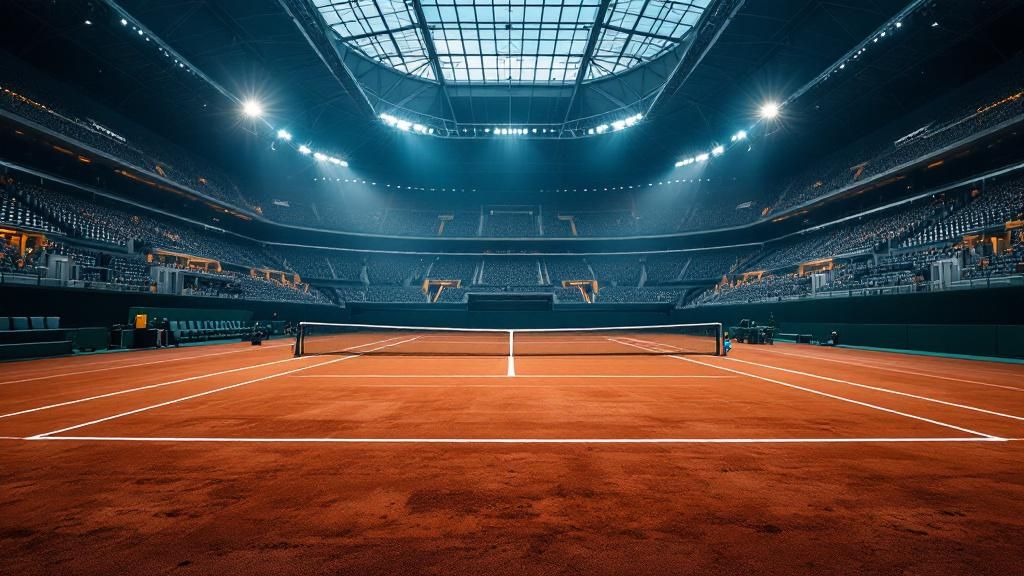
Real Madrid’s iconic Bernabeu stadium will accommodate a practice court for the world’s top-tier tennis players in advance of the Madrid Open the following month. The prestigious venue will momentarily replace grass for clay from 23 to 26 April, providing elite competitors such as Spanish world’s top-ranked player Carlos Alcaraz an opportunity to perfect their readiness for one of the professional game’s biggest tournaments outside the Grand Slams. The practice activities, which will replicate the clay surfaces used at the tournament’s main venue, the Caja Magica, will remain open to the public. The Madrid Open, which spans 20 April to 3 May, combines both the ATP and WTA tours, making it one of the sport’s leading unified competitions.
A stadium converted for the sport of tennis
The choice to utilise the Bernabeu represents an forward-thinking solution to a growing logistical challenge confronting the Madrid Open. The tournament’s expansion to 96-player singles draws played over a fortnight, combined with the addition of doubles events, has stretched the capacity of the Caja Magica beyond its workable constraints. By securing access to one of world football’s most recognisable stadiums, organisers have found a way to cater for the tournament’s expansive development whilst maintaining the standard of preparation facilities available to the world’s top players.
Tournament director Feliciano Lopez stressed that the move serves a legitimate athletic objective rather than merely functioning as a marketing campaign. “The goal is to have a suitable practice facility which helps them – it’s not just a commercial opportunity,” the three-time Wimbledon quarter-finalist told BBC Sport. Lopez emphasised that after word of the arrangement emerged, he has fielded multiple requests from athletes and coaching staff eager to use the facility. Real Madrid have no home fixtures scheduled during the week when their recently refurbished stadium will be converted for tennis use.
- Training opportunities available to elite players between 23-26 April
- Court surfaces will accurately match the Caja Magica clay
- Public access to practice sessions shall be restricted
- Tournament matches will continue exclusively at Caja Magica venue
Why Madrid Open needed extra amenities
The Madrid Open has gone through a considerable transformation in the past few years, moving away from a traditional tournament into one of professional tennis’s most ambitious and cutting-edge events. The increase to 96-player singles draws held over a two-week period, combined with the introduction of full doubles programming, has generated significant strain on available infrastructure. Tournament officials found themselves dealing with a real capacity problem at their traditional home, the Caja Magica, which was unable to accommodate the increased participant numbers whilst maintaining the high standards required by the top-ranked players and their coaching teams.
This expansion illustrates the tournament’s growing prestige and market value within the competitive tennis schedule. As one of the leading tournaments outside the major championships, the Madrid Open brings in the sport’s top players and generates considerable worldwide engagement. However, this achievement produced a contradiction: the very prominence that established the tournament so prized also strained its venue facilities. Tournament director Feliciano Lopez acknowledged that innovative solutions were crucial to maintain the event’s trajectory and maintain appeal to world-class players from both ATP and WTA competitors.
Moving past the initial space
The Caja Magica, situated roughly five miles to the south of central Madrid, has served as the Madrid Open’s home for a considerable period. However, the venue’s constraints became more obvious as the tournament increased in scale and ambition. The facility, whilst suitable for the tournament’s established structure, found it difficult to offer adequate training courts and training facilities for the substantially expanded player group now taking part in the event. This constraint threatened to compromise the calibre of training provided for competitors.
By gaining entry to the Bernabeu, organisers have effectively solved this logistical hurdle whilst simultaneously generating considerable commercial advantage. The renowned stadium’s conversion to a tennis venue demonstrates innovative solution-finding at the top management echelon. The configuration permits the tournament to maintain its competitive integrity and athlete contentment whilst maintaining its expansive expansion path, ensuring the tournament stays among the professional game’s most sought-after and well-resourced tournaments.
Real Madrid’s sporting ambitions expand
Real Madrid’s decision to host a practice court at the Bernabeu represents a strategic expansion of the club’s sporting portfolio beyond football. The 15-time European Cup winners have demonstrated their willingness to embrace forward-looking alliances that enhance their legendary venue’s international standing. By attracting the world’s leading tennis talent to one of sport’s most celebrated grounds, Real Madrid has established itself as a innovative club equipped to stage premier competitions across different sporting fields. This move fits with the club’s overarching strategy of the Bernabeu as a diverse athletic hub, following its recently completed renovation that developed it as a cutting-edge venue.
The structure carries limited disruption to Real Madrid’s competitive schedule, as the club has strategically timed the tennis court installation to avoid key league matches. Should Real Madrid advance past the quarter-final stage in their Bayern Munich tie, any subsequent matches with Liverpool or Paris St-Germain would be contested away throughout that timeframe. This meticulous planning ensures the football club’s sporting priorities stay protected whilst continuing to exploit the commercial and promotional opportunities offered through staging one of tennis’s leading events. The collaboration illustrates the way modern sports organisations can leverage their facilities and brand recognition to strengthen their position within the wider sports landscape.
| Feature | Details |
|---|---|
| Practice court dates | 23–26 April 2026 |
| Tournament dates | 20 April – 3 May 2026 |
| Court surface | Clay, matching Caja Magica specifications |
| Public access | Not open to spectators |
Tournament director Feliciano Lopez has been emphatic that this arrangement constitutes a legitimate competitive venture rather than a surface-level promotional undertaking. The ex-world number 13 player has attracted substantial engagement from players and coaching teams keen to utilise the Bernabeu’s practice facilities during their competitive build-up. Lopez’s vision focuses on concrete value for participants, guaranteeing the partnership serves the tournament’s competitive integrity and athlete wellbeing above all other factors.
Innovative marketing approach combines with practical purpose
The Madrid Open has firmly positioned itself as a competition willing to push boundaries and defy tradition within professional tennis. From unveiling an eye-catching blue clay surface to employing models as ball kids, the tournament has consistently sought to attract global attention through creative ventures. Tournament director Feliciano Lopez has emphasised that the event takes pride in innovative methods and taking calculated risks to provide new experiences for players and spectators alike. This latest venture at the Bernabeu represents the natural evolution of that approach, combining the legendary venue’s global profile with authentic competitive benefits.
Beneath the prestigious surface of hosting matches at one of global tennis’s most renowned venues lies a genuine requirement driving the decision. The Madrid Open’s expansion to 96-competitor singles draws contested over a two-week period, alongside extensive doubles competitions, has rapidly outgrown the Caja Magica’s capacity. By utilising the Bernabeu’s expansive facilities for player preparation, organisers tackle genuine logistical constraints whilst simultaneously generating significant promotional value. This two-pronged strategy ensures the partnership delivers tangible advantages to competitors rather than functioning purely as a marketing spectacle removed from sporting reality.
- Blue clay surface introduced to improve the visual presentation and television presentation
- Fashion models utilised as ball kids in recent tournament editions
- Virtual tournament held during 2020 coronavirus pandemic using gaming consoles
- Tournament expansion necessitates additional facilities exceeding Caja Magica capacity
- Practice court installation addresses player training requirements authentically
Looking forward to tennis at the Bernabeu
Whilst the existing arrangement concentrates solely on practice facilities, the triumph of this inaugural partnership could possibly reshape how the Madrid Open runs in coming years. Tournament director Lopez has been careful to temper expectations, remarking that hosting tournament matches at the Bernabeu continues to be outside the organisation’s immediate plans. However, the benchmark created by other major tournaments cannot be completely overlooked. The Miami Open’s addition of a show court within the Hard Rock Stadium illustrates that such arrangements are feasible at world-class sporting venues, should circumstances and operational factors align favourably in later editions.
For now, the emphasis stays firmly on offering tangible advantages to the world’s leading players during the crucial preparation phase before the main tournament begins at the Caja Magica. The access of a world-class practice venue at one of global sport’s most prestigious stadiums represents an remarkable chance for athletes to refine their clay-court abilities. Whether this turns out to be a standalone showcase or the basis for a sustained partnership will ultimately hinge on how effectively the initiative serves athlete demands whilst preserving the competition’s profile for innovation and quality.
